Concept work · Brand Creation
Still
It was already in the room.
- Category
- None. The product is first of its kind
- Scope
- Naming, identity, nomenclature, packaging, device
- Product
- Capture device and refillable cartridges
The situation
Every other case here escaped a crowded category. This one had no category to escape.
A device that records a real smell and plays it back, and cartridges that hold what it took. It works, it is manufacturable, and it has no category. There is no shelf it belongs on, no competitor to be measured against, and no established language a buyer could use to describe it to a friend. Every previous engagement in this portfolio started by finding a way out of a crowded category. This one had to build the category first.
The enemy
Tobacco Vanille. Fresh Linen. Amber Nights. Every one of them from nowhere.
With no direct competitor, the risk is not losing a comparison, it is being filed under the wrong thing. Perfume and scented candles are the two shelves this gets mistaken for, and both share one habit: they name a smell after a mood. Tobacco Vanille. Fresh Linen. Amber Nights. The moment a smell is given a poetic name it has admitted it came from nowhere, which is the exact opposite of what this product does.
The position
The only device that records a smell that already existed, instead of selling you one that somebody invented.
Nomenclature
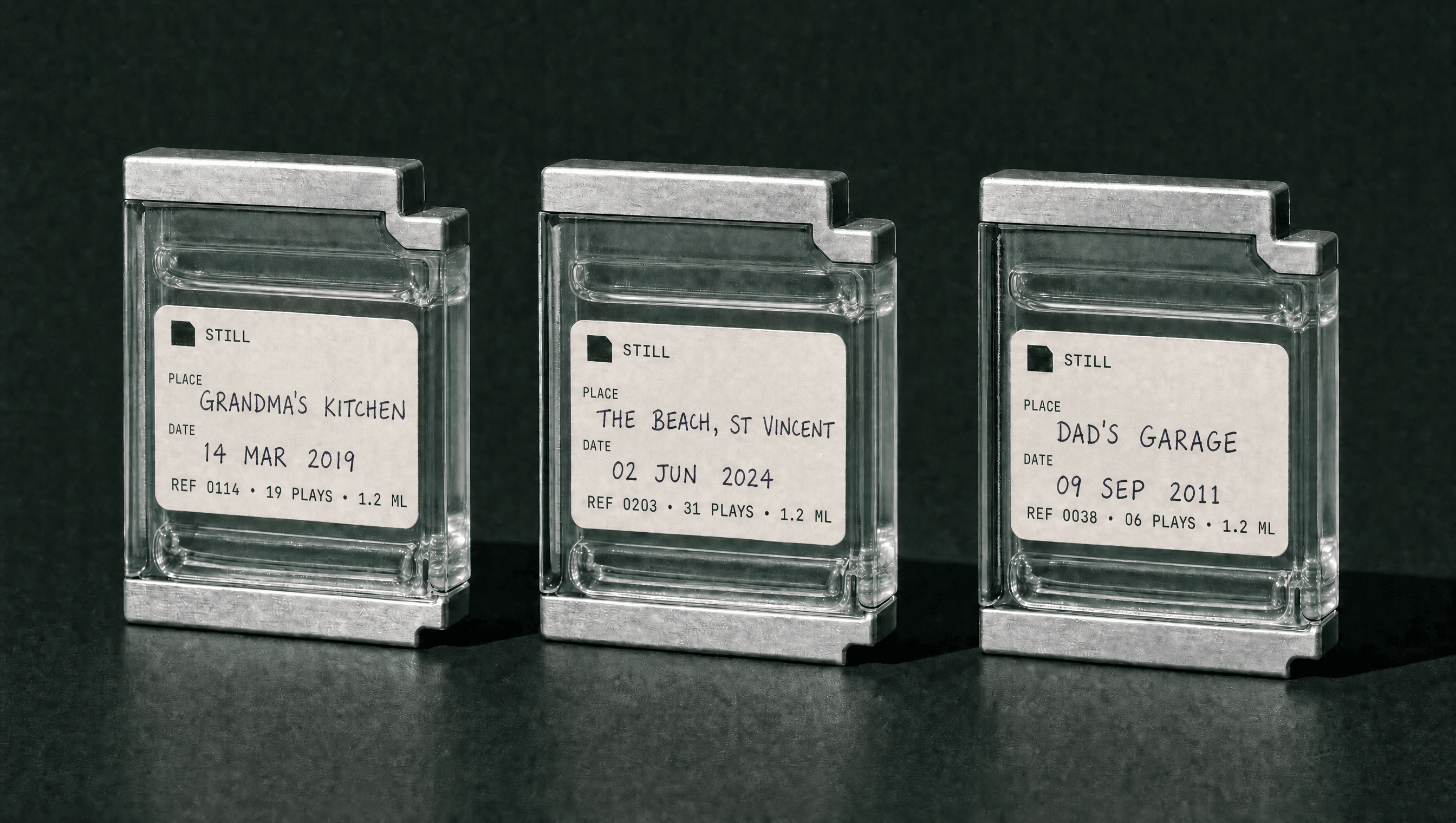
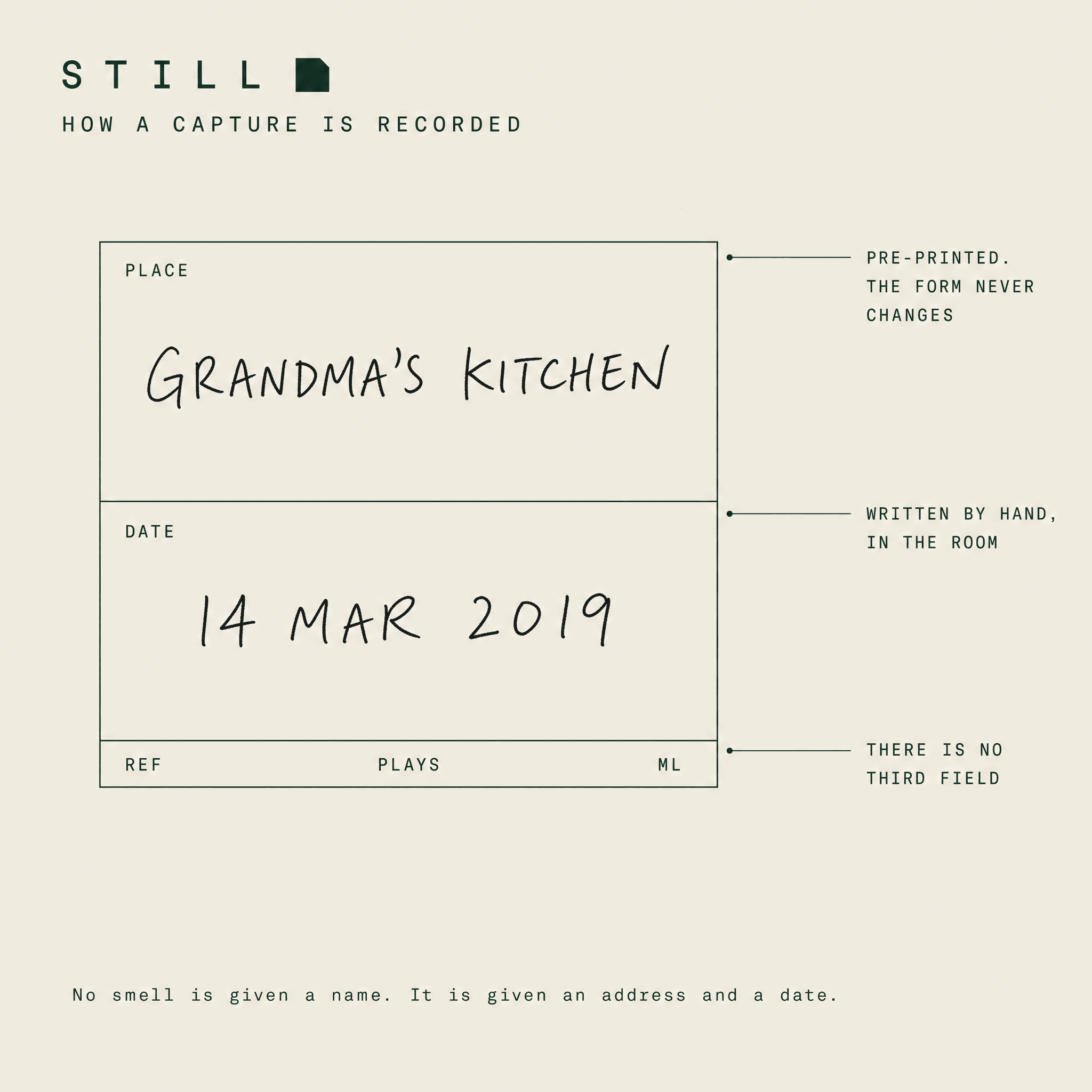
No smell is given a name. It is given an address and a date.
This is the identity. Not the mark, not the palette, the naming rule. Every capture is labelled with the place it was taken and the day it was taken, and never with a description of what it smells of. Kitchen, Orchard Road. 14 March 2019. The rule kills the enemy on contact, it makes two cartridges from the same house distinguishable, and it means the product cannot be marketed with an adjective even if somebody later wants to. A system that forbids its own worst instinct is worth more than one that merely avoids it.
Identity
The mark is the notch that stops it going in wrong
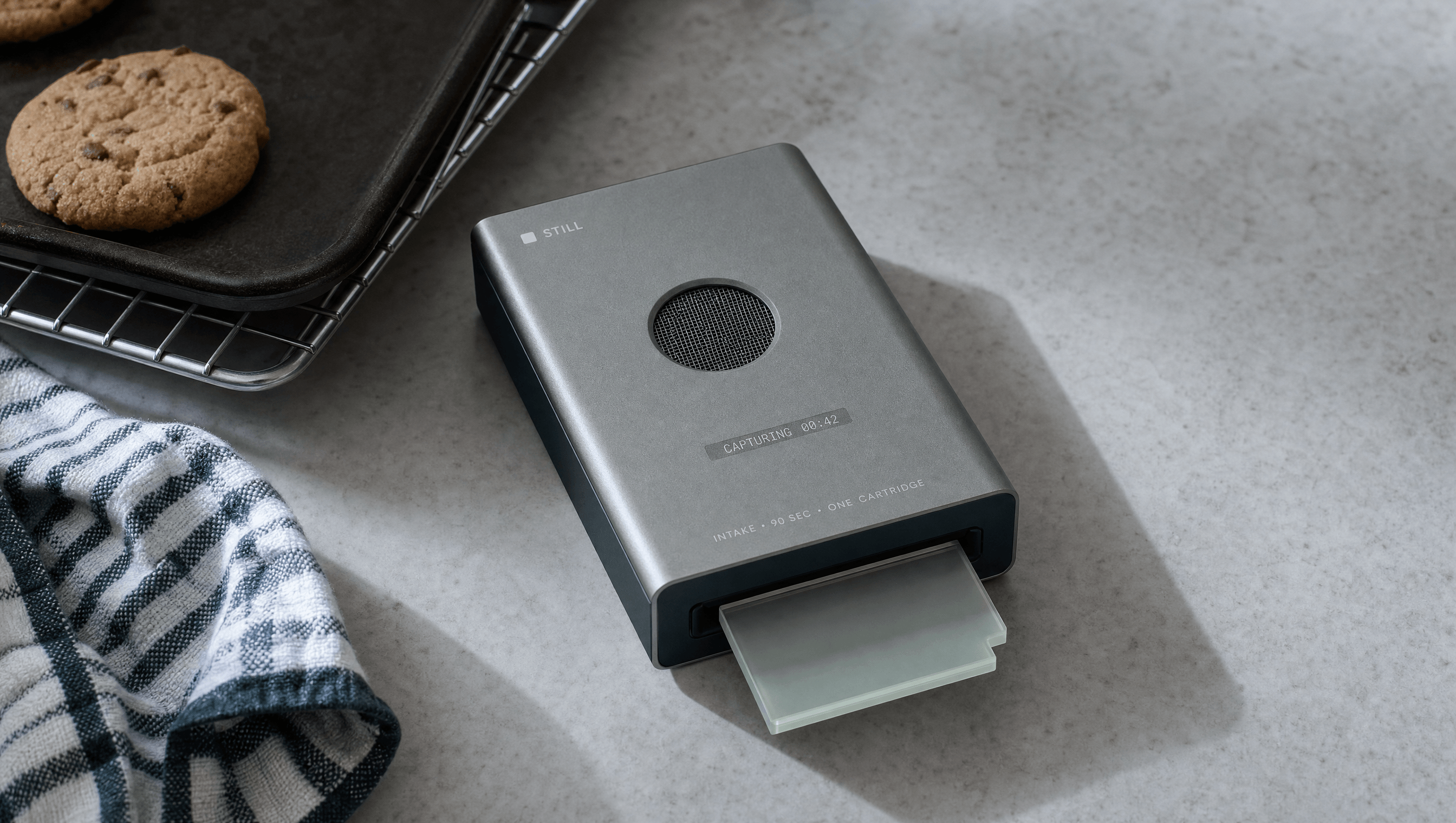
A cartridge is keyed, meaning one corner is cut away so it only seats one way round. That notch is the mark: a filled square with a corner removed. It is a real mechanical feature of the product rather than a symbol invented to represent it, it survives at any size from a drawer front to a label three millimetres tall, and anyone can redraw it correctly from memory.
Colour
There is no accent colour, and that is the argument
Deep green, lab glass, label stock and brushed silver. Four colours, every one taken from the physical object, and no fifth colour added for emphasis. Every other brand in this portfolio has an accent that does the shouting. This one does not, because a decorative colour would be a thing the studio invented, and the single claim the product makes is that nothing here was invented.
Typography
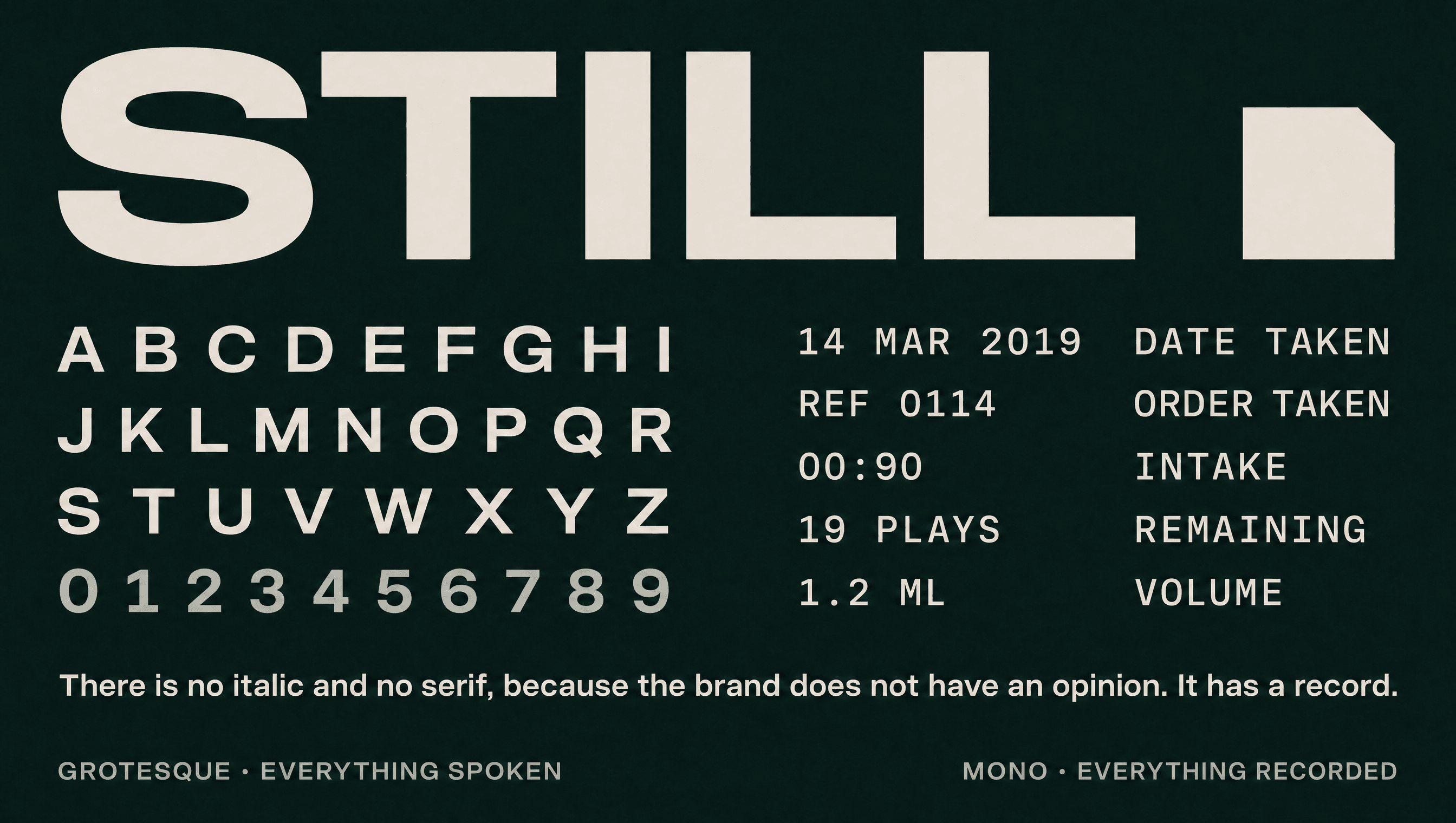
No serif and no italic anywhere in the system
A functional grotesque for anything the brand says, a mono for anything the device recorded. The absence is the decision: a serif carries editorial authority and an italic carries emphasis, and this brand is entitled to neither. It did not compose the smell, it wrote down where the smell was. Type with an opinion would be the first lie the system tells.
Mechanism
The label is a form, and the form is the rule
Every label is pre-printed with two fields and nothing else: where, and when. Whoever took the capture writes both in by hand, in pen, standing in the room it came from. Nothing is automated and nothing is suggested, because the constraint was never about accuracy. It is about what the form refuses to offer. There is no third field. Someone holding a pen over a label with nowhere to write beautiful has already been stopped, and they were stopped by a piece of paper rather than by a rule anybody had to enforce.
Application
The archive is the product, and it lives in a drawer
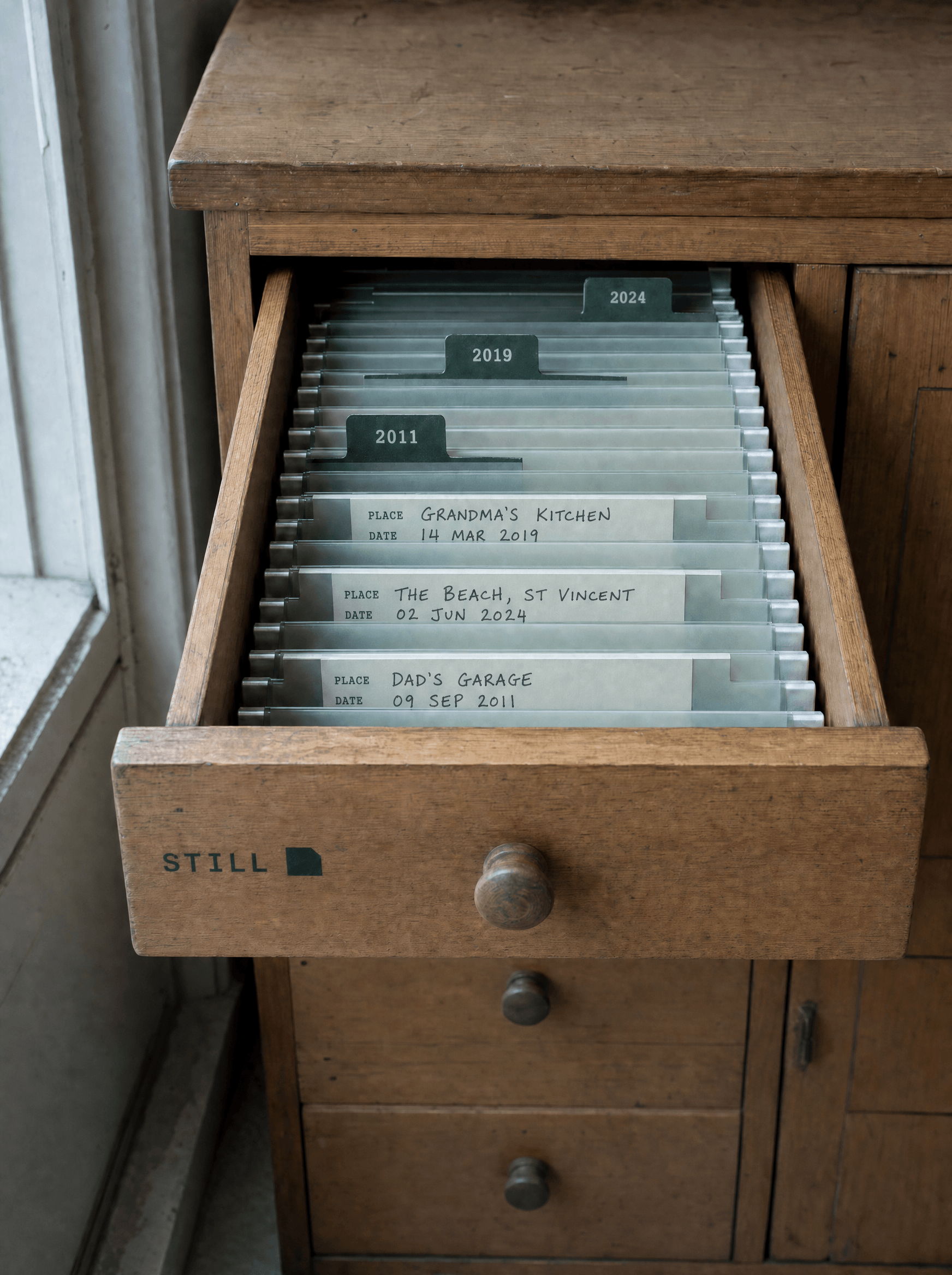
Cartridges are filed upright like index cards behind year dividers, in a sideboard, in a house. It matters that the collection is stored the way documents are and not the way perfume is displayed, because the behaviour being encouraged is keeping a record rather than building a shelf of objects. The oldest cartridge in a drawer is usually the one with the fewest plays left, and the system shows that on the label without ever commenting on it.
Palette
Fix
#12211C
Glass
#C3CFC6
Stock
#EAE6DC
Silver
#8E9691
Voice
The cartridge holds one place, on one day.
Nothing here was invented.
Ninety seconds. One cartridge.
Six plays left.
We did not name it. We wrote down where it came from.
Flat declarative sentences about what the object did, never about how it will make you feel. The product touches grief, memory and childhood, so any reaching for emotion would be the brand doing the feeling on the customer's behalf. It states the record and gets out of the way, and the restraint is what makes it bearable to use.
Typefaces
Functional Grotesque
Everything spoken
Mono
Everything recorded: place, date, ref, volume
Credits
Kyle C., Brendan Forbes
Strategy, identity and art direction
Next
Ponza